




Why Are My Dishes Still Wet When the Dishwasher Finishes?
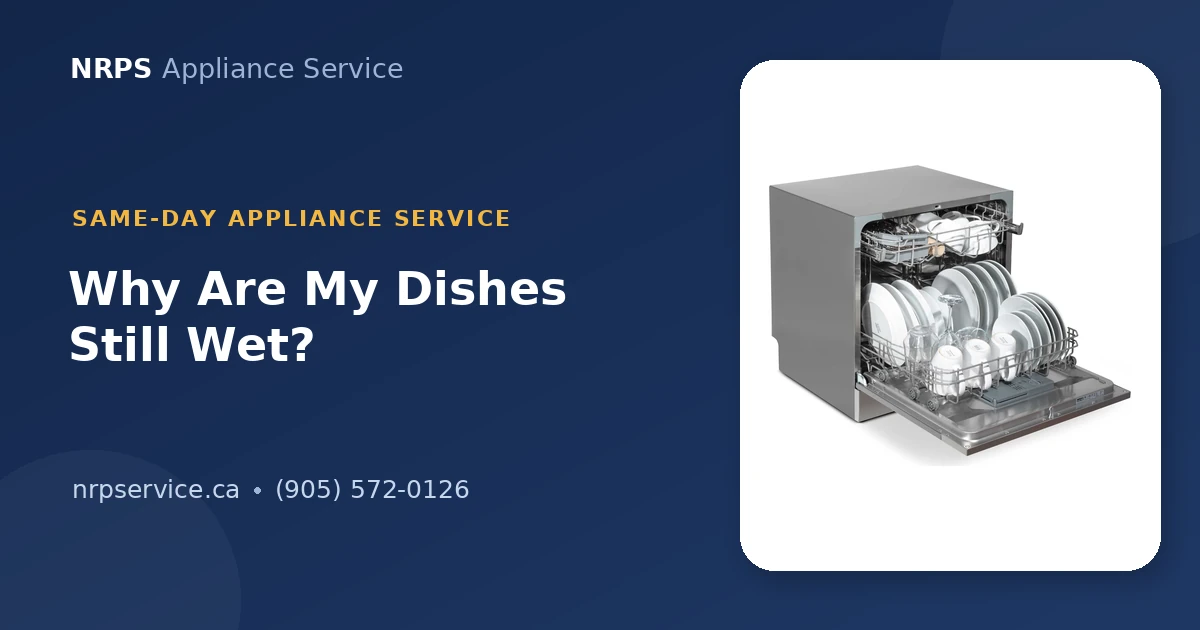
Why Are My Dishes Still Wet When the Dishwasher Finishes?
Dishes still wet after the cycle? How dishwasher drying actually works, the free fixes to try first, and when it is a genuine fault worth repairing.
You open the dishwasher expecting clean, dry dishes and instead you get puddles in the cup bottoms and plastic containers you have to towel off by hand. It is one of the most common dishwasher complaints, and one of the few where the answer is often not a repair at all. Before assuming something has failed, it helps to know how your dishwasher actually dries, because that determines what you can reasonably expect from it.
First: how does your dishwasher dry?
There are two approaches, and they behave very differently.
|
Drying method |
How it works |
What to expect |
|
Heated dry |
A heating element in the base warms the air at the end of the cycle. |
Most items come out dry, including plastics. Uses more energy. |
|
Condensation drying |
The final rinse is very hot, so water evaporates and condenses on the cooler stainless steel tub, then drains away. |
Glass and ceramics dry well. Plastics often stay damp, by design. |
This matters: condensation drying is standard on most European style dishwashers and increasingly common elsewhere, because it is far more energy efficient. On those machines, damp plastic containers are normal behaviour rather than a fault. Everything wet, including glass, is a different story.
Normal, or a genuine fault?
Use this as a quick sorting test before going further:
• Plastics damp, glass and ceramics dry: almost certainly normal on a condensation drying machine.
• Everything damp, including glassware: something is reducing performance, and the steps below will usually find it.
• Pools of water sitting in upturned cup bottoms: that is loading rather than drying.
• Dishes cold and wet, with no warmth in the tub at all: points to a heating fault, which is a repair.
The drying ladder
Work through these in order. They run from free and instant through to the point where a technician is genuinely needed, and most people solve the problem in the first two steps.
Step 1 Check the rinse aid, because this is the most common answer
Rinse aid is not a luxury extra. It lowers the surface tension of water so it sheets off surfaces instead of forming droplets, and on a condensation drying machine it makes the single biggest difference to results. If the reservoir is empty, or if you have never filled it, that alone explains a great deal.
Fill it, and if your machine has an adjustable dosage setting, turn it up a level. Many machines ship on a low default.
Step 2 Look at how the load is stacked
Water sits wherever gravity lets it. Cups, bowls and anything with a concave base will hold a puddle unless they are angled.
• Tilt cups and bowls rather than sitting them flat.
• Keep plastics on the top rack, away from the heat source and where airflow is better.
• Avoid overlapping items, since water trapped between two surfaces cannot evaporate.
• Leave a little space rather than packing the racks completely.
Step 3 Check the cycle you are selecting
Eco and quick cycles use lower temperatures, and lower temperature means less residual heat to drive evaporation at the end. If you always run the shortest setting and then wonder why nothing dries, the cycle is the answer. Try a normal or heavy cycle, and if your machine has an extra dry, sanitise or heated dry option, use it.
Step 4 Give it a moment before you unload
Condensation drying continues after the cycle ends, and opening the door immediately releases the warm air that is doing the work. Many machines now open the door slightly on their own for exactly this reason. If yours does not, leaving it closed for twenty minutes after the cycle finishes, then opening the door and waiting a few more, noticeably improves results.
There is also a loading order trick worth knowing: unload the bottom rack first. Water pooled on upper rack items drips down onto dishes below, so doing it the other way round re-wets what was already dry.
Step 5 Now consider a fault
If rinse aid is full, loading is sensible, the cycle is a normal one, and everything still comes out cold and wet, the machine itself is worth checking. The usual causes are:
• A failed heating element. On heated dry machines this stops drying entirely, and you may also notice the wash water is not as hot as it should be.
• A faulty high limit thermostat. It can cut heating short as a protective measure, so the cycle completes but never reaches temperature.
• A vent or fan fault. Many machines vent moist air at the end of the cycle. If the vent flap is stuck or the fan has failed, the moisture stays inside and settles back onto the dishes.
• A rinse aid dispenser that is not releasing. The reservoir looks full because nothing is coming out, which mimics an empty one.
• A low incoming water temperature. If the water arriving at the machine is not hot enough, neither the wash nor the drying performs properly.
Dishwasher repair when it is a real fault
NRPS repairs dishwashers from all major brands, including built in and integrated units, where replacement means matching your cabinetry and is rarely worth it. Heating elements, thermostats, vents, dispensers and control faults are all routine work. Our pricing is flat and confirmed upfront, and you will find the details on our dishwasher repair service page. If your dishwasher is also leaving food behind or refusing to drain, our dishwasher troubleshooting guide covers those symptoms.
Fewer surprises with a care plan
If you would rather not think about appliance faults at all, an NRPS care plan includes labour, gives you priority scheduling, and covers every appliance in your home under one membership. See how the care plans work →
Dishes still coming out wet after all that? Call (905) 572-0126 or book online and we will find the cause.