




Why Is One Cooktop Burner Not Working?
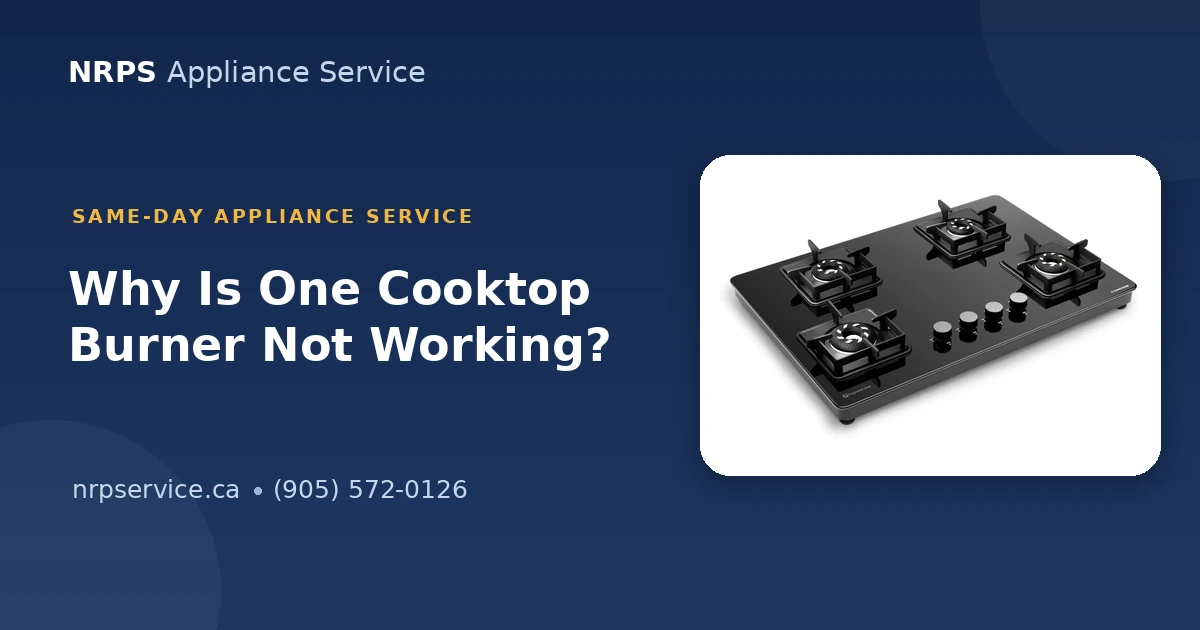
Why Is One Cooktop Burner Not Working?
One burner dead, or all of them? That single question splits the diagnosis in two. Here is what it means on gas, coil, ceramic and induction cooktops.
A cooktop with a dead burner is an annoying fault rather than an emergency, which is why people live with it for months and cook around the gap. It is also one of the more diagnosable appliance problems, because two questions narrow it down almost completely.
Question one: one burner or all of them?
This is the question that decides everything else, and it takes five seconds to answer.
|
What you find |
Where the fault is |
|
One burner dead, the rest fine |
That burner's own components. The cooktop as a whole is healthy, and the repair is contained. |
|
All burners dead |
Power supply, the control board, or on a gas unit the gas supply itself. Nothing to do with any individual burner. |
|
All burners weak rather than dead |
Supply pressure on gas, or a voltage problem on electric. |
|
Burners fine but the oven is dead |
On a range these are often separate circuits, so this is normal and points at the oven. |
A free test for the single burner case: on a gas cooktop or a coil cooktop, swap the dead burner with a working one of the same size. If the fault moves with the part, the burner or element is at fault. If the fault stays in the same position, the problem is in that position's wiring, igniter or switch. Technicians use this constantly and it costs nothing.
Question two: which kind of cooktop is it?
The components behind a burner are completely different depending on the type, so the causes do not carry over.
Gas
A gas burner that clicks but will not light is usually dealing with one of three things. The burner ports are clogged with spilled food, so the gas cannot reach the spark. The burner cap is sitting slightly out of position, which is very common after cleaning and stops the flame spreading. Or the igniter itself has failed.
A burner that lights but burns yellow and sooty instead of blue is not getting the right air to gas mixture, and that is worth looking at rather than ignoring.
If nothing clicks at all on any burner, the control module that drives the igniters is the usual cause.
Gas work is regulated in Ontario. Cleaning burner ports and reseating a burner cap are homeowner jobs. Anything involving the gas valve, the orifices, the supply line or the igniter wiring is not. Gas appliance work requires the appropriate certification. If you smell gas, leave the house and call your gas utility's emergency line first.
Electric coil
The simplest type and the easiest to diagnose. Coils plug into a socket, so a coil that does not heat is usually either the element itself or the socket it plugs into, which can burn and pit over time. The swap test above settles which in a minute. Burnt or discoloured contacts in the socket are a repair rather than something to keep using.
Glass or ceramic
The elements sit under the glass surface, so nothing is accessible, and the usual failures are the element, the infinite switch that controls its power, or the surface sensor. A specific pattern worth knowing: if a burner heats but will not hold a low setting, cycling hard between full heat and nothing, that normally points at the switch rather than the element.
Cracks in the glass are a different matter. A cracked ceramic surface should be taken out of use, because liquid reaching the element underneath creates an electrical hazard.
Induction
Induction cooktops fail differently, and often what looks like a fault is not one.
• The pan is not magnetic. Induction only works with ferrous cookware. If a fridge magnet does not stick to the base of the pan, the cooktop cannot heat it, and that is the appliance working correctly.
• The pan is too small. Most induction zones need the pan to cover a minimum diameter before they will switch on at all.
• It shut itself down. Induction units have cooling fans and will stop if they overheat, often because the vents underneath are obstructed.
• A genuine fault. Usually the induction coil or the control board, both of which need diagnosis.
The causes that apply to any type
• A tripped breaker, including one half of a double breaker, which can leave part of a cooktop alive and part dead.
• Control lock. Most modern cooktops have a child lock that disables the controls entirely, and it can be switched on by accident. The manual will say how to clear it.
• A failed control board, which tends to produce erratic behaviour across several burners rather than one clean failure.
• Spills under the controls, which cause intermittent faults that come and go with no obvious pattern.
What you can safely check
1. Establish whether it is one burner or all of them.
2. Check the breaker, including both halves of a double breaker.
3. Check the control lock is not engaged.
4. On gas, lift the burner cap, confirm it is seated correctly, and clear the ports with a pin or a stiff brush once the cooktop is cold.
5. On coil, swap two elements and see whether the fault moves.
6. On induction, test the pan with a magnet and check the vents are clear.
7. On any type, clean around the controls in case a spill is causing intermittent behaviour.
Cooktop repair
NRPS repairs cooktops of every type, including gas, electric coil, ceramic and induction, from all major brands, on both built in cooktops and freestanding ranges. Igniters, elements, switches, sensors and control faults are routine work. Our pricing is flat and confirmed upfront, and the details are on our cooktop repair service page. If the oven below is also misbehaving, that is a separate system and our guide to an oven not heating properly covers it.
Fewer surprises with a care plan
If you would rather not deal with faults like this at all, an NRPS care plan includes labour, gives you priority scheduling, and covers every appliance in your home under one membership. See how the care plans work →
Burner out? Call (905) 572-0126 or book online, and tell us whether it is one burner or all of them when you call.