



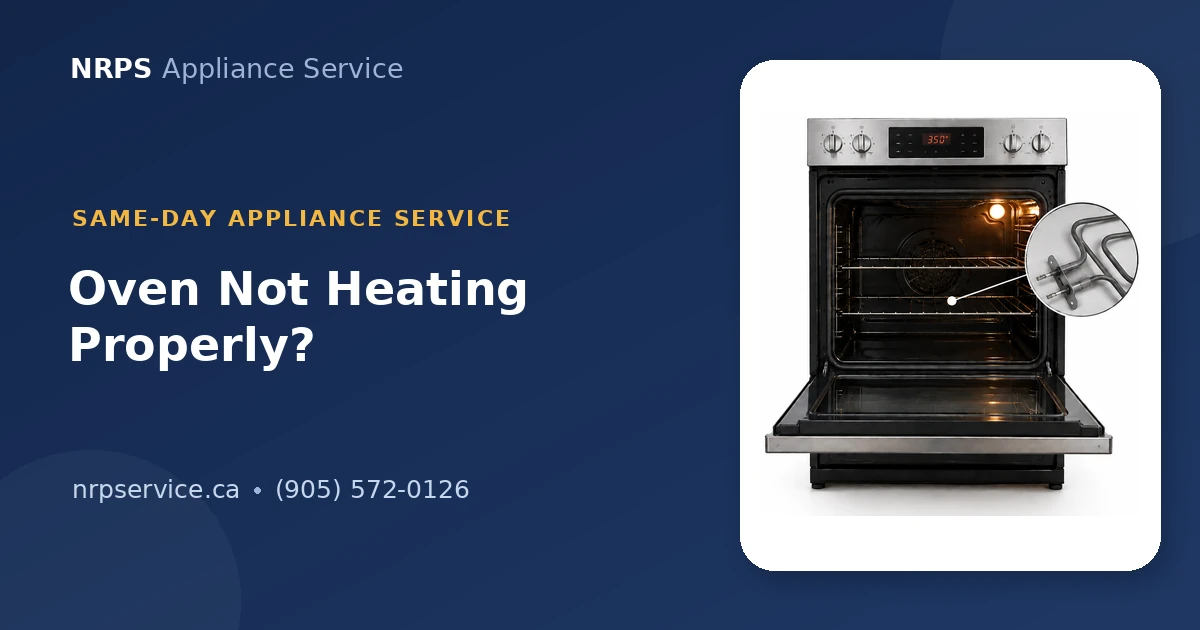
Why Is My Oven Not Heating Properly?
Why Is My Oven Not Heating Properly?
Oven not heating, taking forever, or baking at the wrong temperature? These are four different faults. Find out which one you have, and what causes it.
Everybody phones with the same sentence: the oven is not heating. But four quite different things hide behind it, and they have almost nothing in common mechanically. One is a dead heating circuit. One is a heating circuit that works but cannot keep up. One is an oven that heats perfectly well to the wrong number. And one is an oven that heats correctly but cooks unevenly.
Sorting yours into the right group takes a minute, and it changes everything that follows.
Which of the four do you have?
|
What actually happens |
What kind of fault it is |
|
No heat at all, oven stays cold |
A broken heating circuit. On electric, usually an element. On gas, usually the igniter. |
|
Heats, but takes far longer than it used to |
A weakening component, most often a tired gas igniter or a partly failed element. |
|
Reaches temperature, but food burns or undercooks |
A calibration or sensor problem. The oven is accurate about the wrong number. |
|
One side or one shelf cooks faster |
Airflow, a convection fan fault, or an element heating unevenly. |
|
Heats then shuts off partway through |
A thermal safety device or a control fault, and worth looking at promptly. |
Fault one: no heat at all
If it is electric
Electric ovens have two elements: the bake element along the floor and the broil element at the roof. Start by looking at the bake element with the oven cold and switched off. A failed element usually shows itself, with a visible break, a blistered patch or a bright spot where it burned through. If the broil element glows but the bake element never does, that is a strong sign on its own.
If neither element does anything and the display is working, the fault sits further back: the thermal fuse, the control board, or the relay that switches the element. If the display is dead too, check the breaker first, because many ovens run on a double breaker where one half can trip and leave the appliance partly alive.
If it is gas
The igniter is the most common failure on a gas oven by a wide margin, and it fails in a way that is genuinely counterintuitive.
The detail most people miss: a gas oven igniter does two jobs. It gets hot enough to light the gas, and it draws enough electrical current to open the safety valve. As it ages it weakens, so it still glows orange and looks perfectly healthy, but it no longer draws the current the valve needs. The oven looks like it is trying, and no gas ever arrives.
So if you can see a glow but never get a flame, or the burner takes several minutes to light when it used to take seconds, the igniter is the likely answer even though it appears to be working.
Fault two: it heats, but far too slowly
A normal oven reaches a standard baking temperature in roughly ten to fifteen minutes. If yours now takes half an hour, something is weakening rather than broken.
• On gas: a tired igniter again, this time at an earlier stage. The valve opens eventually, so you do get heat, just much later than you should.
• On electric: an element that has partly failed, or a relay that is not closing reliably.
• On either: a door that no longer seals. Heat escaping as fast as it is made shows up as an oven that never quite gets there, and it is easy to overlook because the door still closes normally.
The door is worth checking first because it costs nothing. Look along the gasket for flattened, torn or missing sections, and watch for heat or steam escaping around the door edge while the oven runs.
Fault three: it heats to the wrong temperature
This is the one that produces burnt bases and raw middles while the display insists everything is fine. The oven is not failing, it is being lied to.
How to prove it, in twenty minutes:
1. Put an oven thermometer on the middle shelf, in the centre.
2. Set the oven to a standard baking temperature and wait for the preheat signal.
3. Wait another twenty minutes after that signal, because ovens overshoot and settle.
4. Read the thermometer without opening the door for long.
A gap of a few degrees is normal. A gap of fifteen or twenty is why your baking has been unreliable. Many modern ovens have a calibration offset setting in the menu that lets you correct a small drift yourself, and the manual will say how. A large gap usually means the temperature sensor has drifted and needs replacing, which is a routine repair.
One more possibility worth knowing: a sensor probe touching the oven wall reads the wall rather than the air, which throws the whole cycle off. It is a small thing with a large effect.
Fault four: it cooks unevenly
Here the temperature may be perfect and the problem is distribution.
• A convection fan that has stopped turns a fan oven back into a conventional one, so the even baking you are used to disappears while the oven still heats correctly.
• Blocked airflow, usually from foil laid on the oven floor or a tray covering most of a shelf. Foil on the floor is a common habit and it genuinely disrupts both airflow and the heat pattern.
• An element heating unevenly, bright in one section and dull in another, which is an element approaching failure.
• Overcrowding, since two full trays side by side leave nowhere for hot air to circulate.
What you can safely check yourself
5. Check the breaker, including both halves of a double breaker on an electric range.
6. Look at the bake element cold, for breaks, blisters or burn marks.
7. Run the thermometer test above before assuming anything is broken.
8. Inspect the door gasket for flattened or torn sections, and feel for escaping heat along the edge.
9. Remove foil from the oven floor and any tray that covers a whole shelf.
10.Check the oven is not stuck in a special mode such as Sabbath mode, delayed start or a self clean lockout, all of which can leave an oven refusing to heat normally.
Gas work is regulated in Ontario: do not attempt repairs to igniters, valves or any gas component yourself. Gas appliance work requires the appropriate certification, and this is one area where the rules exist for good reason. If you smell gas, leave the house and call your gas utility's emergency line before anyone else.
When to call a technician
Book a diagnosis if the oven produces no heat, if it takes dramatically longer than it used to, if the thermometer test shows a large gap that the calibration setting cannot correct, or if the oven shuts itself off partway through a cycle. That last one often means a thermal safety device is tripping, and it is worth finding out why rather than working around it.
NRPS repairs gas and electric ovens and ranges from all major brands, including bake and broil elements, igniters, temperature sensors, thermostats, convection fans, door seals and control faults, on freestanding ranges and built in wall ovens alike. Our pricing is flat and confirmed upfront, and the details are on our oven repair service page. If the burners on top are also giving trouble, that is a separate system and our cooktop repair service covers it.
Fewer surprises with a care plan
If you would rather not deal with faults like this at all, an NRPS care plan includes labour, gives you priority scheduling, and covers every appliance in your home under one membership. See how the care plans work →
Oven not heating the way it should? Call (905) 572-0126 or book online, and tell us which of the four it is when you call.