




Dryer Not Heating? Start With Gas or Electric
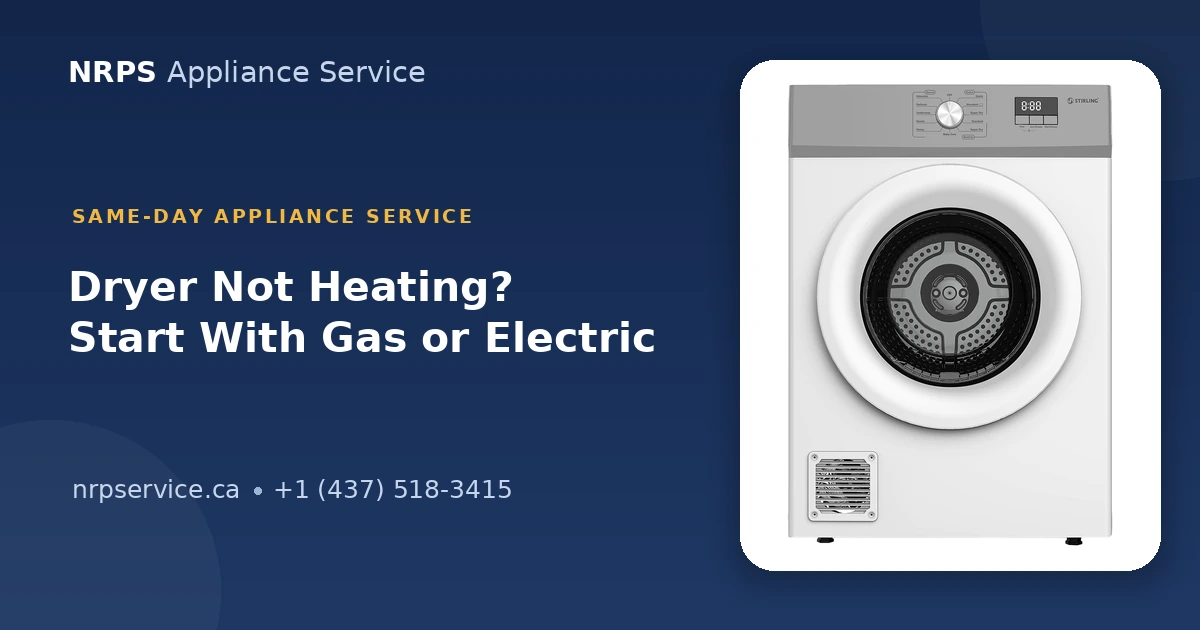
Dryer Not Heating? Start With Gas or Electric
Dryer tumbles but the clothes come out cold? The cause depends on whether it runs on gas or electricity. Check these first, then know when to call.
The drum turns, the timer counts down, and at the end of the cycle the laundry is as damp and cold as when it went in. A dryer that runs without heating is one of the most common calls we get, and the useful part is that the list of possible causes is short.
It is short, though, only once you know one thing about your machine: does it heat with electricity or with gas? The two use completely different parts to make heat, so they fail in different ways. Look at the back of the dryer. A flexible gas line and a standard household plug means gas. A large, heavy plug in a dedicated outlet with no gas line means electric.
Before anything else: three checks for every dryer
Is it set to heat at all?
Air Fluff, Air Dry, Wrinkle Release and some Delicate settings use little or no heat on purpose. A dial knocked one notch, or a cycle chosen by someone else in the household, explains more no heat calls than you would expect.
Is the vent clear?
A blocked vent rarely stops heat on its own, but it is the reason the safety parts below fail in the first place. If you replace a blown part without clearing the vent, the new part fails too. Our guide on how to clean a dryer vent walks through it.
Is the lint screen clean?
Clean it, and if it looks clean, wash it with warm soapy water. Fabric softener sheets leave an invisible film that blocks airflow, and a screen that holds water instead of letting it pass through is a screen that is starving the dryer of air.
Track A: electric dryers
An electric dryer makes heat with a coiled element, a little like a large toaster. Electricity passes through a chain of parts on the way there, and a break anywhere in that chain means no heat.
Half a breaker
This is the one people never think of. An electric dryer uses two circuits joined together in a double breaker. The motor runs on one half and the element needs both. If one half trips, the dryer turns on, tumbles and runs its full cycle, but never warms up. Go to the panel, switch the dryer breaker fully off and back on, even if it looks fine.
The thermal fuse
A small one time safety device that cuts power when the dryer overheats. On many models a blown fuse stops the whole dryer, while on others it only kills the heat. Either way, a blown thermal fuse is a symptom. Something made the dryer overheat, and nine times out of ten it is restricted airflow.
The heating element
Elements break like a light bulb filament: a gap opens in the coil and current stops flowing. Sometimes a break is visible as a separated coil, but often it can only be confirmed with a meter.
The high limit and cycling thermostats
These switch the element on and off to keep temperature in range. When one fails open, the element never receives power. They tend to fail after years of running hot, which again points back at airflow.
Track B: gas dryers
A gas dryer lights a burner, and the sequence that makes that happen is easy to watch. Pull out the dryer, take the small access panel off the lower front if your model has one, start a heat cycle and look through. What you see narrows it down quickly.
|
What you see |
Likely cause |
|
The igniter glows, then goes dark, no flame |
Gas valve coils are not opening the valve. A very common and inexpensive repair. |
|
The igniter never glows |
Failed igniter, or the flame sensor or thermal fuse is preventing it from receiving power. |
|
Flame lights, then goes out within seconds |
Gas valve coils weakening as they warm up, or a problem with the gas supply. |
|
Nothing at all happens |
Check the gas shutoff valve behind the dryer is open, then the thermal fuse. |
Gas work is not DIY in Ontario. Looking through the access panel is fine. Disconnecting, adjusting or replacing anything on the gas side is work for a TSSA certified technician. If you smell gas at any point, leave the house and call your gas utility from outside.
Why the same part keeps failing
We see it often: a thermal fuse replaced in spring, blown again by autumn. The dryer is not defective. It is suffocating. Long vent runs, crushed foil ducting behind the machine, a bird nest in the outdoor hood or a winter snowdrift over the flap all trap heat inside the drum. The fuse does exactly what it was designed to do. Any repair that does not include checking the airflow is half a repair.
Related: If your dryer does heat but takes two or three cycles to finish a load, that is a different problem with a different fix list. See why a dryer takes too long to dry.
Why a dryer takes too long to dry →
Dryer repair
NRPS repairs electric and gas dryers from every major brand, including elements, thermal fuses, thermostats, igniters and gas valve coils. Our technicians are TSSA certified for gas appliances, and every repair includes an airflow check so the fix lasts. Pricing is flat and confirmed before work starts, with full details on our dryer repair service page.
Fewer surprises with a care plan
If you would rather not deal with faults like this at all, an NRPS care plan includes labour, gives you priority scheduling, and covers every appliance in your home under one membership. See how the care plans work →
Cold clothes at the end of the cycle? Call (437) 518-3415 or book online.