



Why Is My Microwave Running but Not Heating?
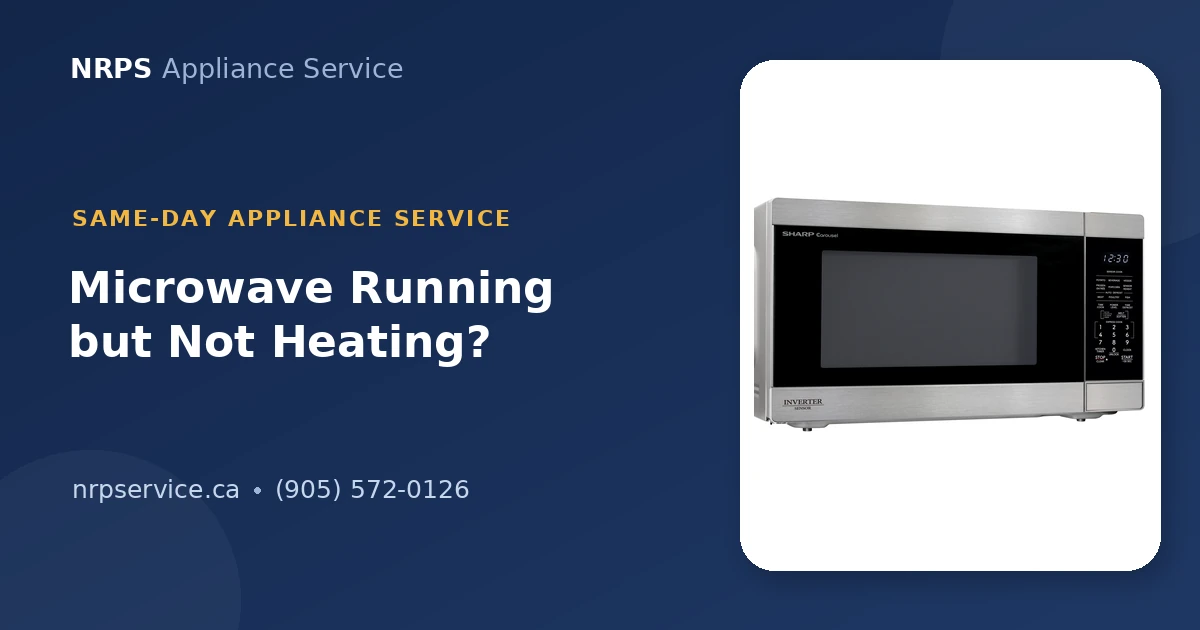
Why Is My Microwave Running but Not Heating?
Microwave runs, light on, plate turning, but the food is still cold? Here is the one-minute test technicians use, and why this is the one appliance never to open.
The light comes on. The turntable spins. The fan runs and the timer counts down. Everything about the microwave says it is working, and then you take out a plate of food that is exactly as cold as when it went in.
It is an unsettling fault because nothing looks wrong. What has happened is that the part which actually produces the heat has stopped, while everything around it carries on as normal. Before you go further, there is a simple test worth doing, and after that there is one piece of safety information that matters more than anything else in this article.
The one-minute test
This is the test technicians use, and it turns a vague complaint into a clear answer.
1. Fill a microwave safe cup with about a cup of cold tap water.
2. Put it in the centre of the turntable.
3. Run the microwave on full power for exactly one minute.
4. Carefully feel or measure the water.
A healthy household microwave will raise that water temperature noticeably, and after a minute it should be hot enough that you would not want to keep your finger in it. Water that is barely warmer than when it went in, or completely unchanged, confirms a real heating fault rather than an oversensitive sense that food is taking longer than it used to.
Never run a microwave empty. With nothing to absorb the energy it reflects back into the magnetron and damages it. This is also why the test uses water rather than an empty cavity, and why a microwave that has been run empty a few times may be the reason you are reading this.
What the result tells you
|
What happens |
What it points to |
|
Runs normally, water stays cold |
The high voltage circuit that produces the microwaves has failed. Technician territory, and the reason is below. |
|
Runs, water warms a little but slowly |
A weakening magnetron, or the unit running on a reduced power setting. |
|
Nothing happens at all, display dead |
Power supply, the outlet, or a blown fuse inside. |
|
Display works but it will not start |
Door switches, by a wide margin the most common cause. |
|
Loud buzzing or humming while running |
A failing component on the high voltage side. Stop using it. |
|
Works, but the display is in a demo mode |
Not a fault at all. See the note further down. |
The safety point that matters most
A microwave is the one household appliance we tell people never to open, and this is not a liability disclaimer. It is the single most important thing on this page.
Inside every microwave is a high voltage capacitor. It stores a charge large enough to be lethal, and it holds that charge after the appliance is unplugged, sometimes for a long time afterwards. Unplugging the microwave does not make the inside safe. People have been seriously injured and killed by touching the inside of a microwave they believed was safe because it was unplugged.
Please treat this as a hard rule: do not remove the outer casing of a microwave, for any reason, including to look, to clean, or to change the light bulb on an over the range model. The charge has to be discharged deliberately with the right tool before anything inside can be touched safely.
Everything you can usefully check is on the outside, and the list below is short on purpose.
Why it runs but does not heat
Heat in a microwave comes from a single component, the magnetron, supported by a small high voltage circuit around it. All of the following sit on that circuit, all of them produce the same symptom, and all of them are behind the casing.
• The magnetron. The part that generates the microwave energy. It wears out, and a worn one often heats weakly before it stops entirely.
• The high voltage diode. A common failure, and a cheap component in itself.
• The high voltage capacitor. The component described above.
• The high voltage transformer. Less common, and usually announces itself with noise or a smell.
• A thermal cutout. A safety device that shuts the heating side down when the magnetron overheats, often because the vents are blocked. The microwave still runs, it just never heats.
That last one is worth knowing, because it can be caused by something as simple as an over the range microwave with grease clogged filters and no airflow. It is also why persistent overheating is worth diagnosing rather than living with.
Why it will not start at all
If the display works but pressing start does nothing, the door is the first place to look.
Microwaves use three separate interlock switches in the door latch, and they have to operate in a specific order every time the door closes. It is a deliberately strict safety design, because the appliance must be certain the door is shut before it produces anything. As the latch wears, or if the door has been slammed or has dropped slightly on its hinges, the switches stop operating cleanly and the microwave simply refuses to run.
From outside it looks completely dead, which makes people assume the worst. In practice this is one of the more straightforward microwave repairs, and it is well worth having checked before writing the appliance off.
Two things that are not faults
Demo or showroom mode
Many microwaves have a display mode intended for shop floors. The panel lights up, the timer counts down, the turntable turns, and the unit produces no heat whatsoever, because that is exactly what it is designed to do. It can be switched on accidentally through a button combination, particularly by children or during a power interruption. If your microwave is fairly new, or the fault appeared out of nowhere with nothing else changing, check the manual for demo mode before anything else. It is a two minute fix and it costs nothing.
A power level left low
If someone set the power to a low level for defrosting and it was never set back, food heats slowly and the appliance appears weak. Worth ruling out before assuming a component failed.
Repair or replace, honestly
This is where microwaves differ from every other appliance we work on, and it deserves a straight answer rather than a sales pitch.
|
Type |
What usually makes sense |
|
Basic countertop model |
On an inexpensive unit, a major high voltage repair can approach the cost of replacing it. We will tell you when that is the case rather than quoting the work. |
|
Over the range model |
Repair almost always wins. It is mounted, vented and sized to the space above your range, so replacing it is an installation job as well as a purchase. |
|
Built in or trim kit model |
Repair, in nearly every case. The unit has to match the cabinetry opening, and a replacement often means altering the kitchen. |
|
Premium or microwave drawer |
Repair. These are expensive appliances and the components are the same components. |
The pattern is simple. The cheaper and more portable the microwave, the more likely replacement is sensible. The more it is built into your kitchen, the more clearly repair is the better outcome.
What you can safely check yourself
5. Run the one minute water test, so you know what you are dealing with.
6. Check the outlet by plugging in something else, since microwaves draw heavily and can trip a breaker.
7. Check the power level setting and the cook time were actually entered.
8. Check the manual for demo or showroom mode, particularly if the fault appeared suddenly.
9. Look at the door for a worn, cracked or sticking latch, and see whether it closes with the usual positive click.
10.On an over the range model, clean the grease filters underneath, since blocked airflow causes overheating shutdowns.
Then stop. There is nothing else on this appliance that a homeowner can safely check, for the reason set out above.
Microwave repair
NRPS repairs microwaves of all types, including countertop, over the range, built in and microwave drawer models, from all major brands. Magnetrons, diodes, door switches, thermal cutouts, turntable motors and control faults are all routine work, carried out with the high voltage side discharged properly first. Our pricing is flat and confirmed upfront, and the details are on our microwave repair service page. If your over the range unit also vents poorly, that is a separate system and our guide to a range hood not clearing smoke covers it.
Keep every appliance covered
If you would rather not deal with faults like this at all, an NRPS care plan includes labour, gives you priority scheduling, and covers every appliance in your home under one membership. See how the care plans work →
Microwave running cold? Call (905) 572-0126 or book online, and leave the casing closed until we get there.