



Garbage Disposal Humming, Jammed or Silent?
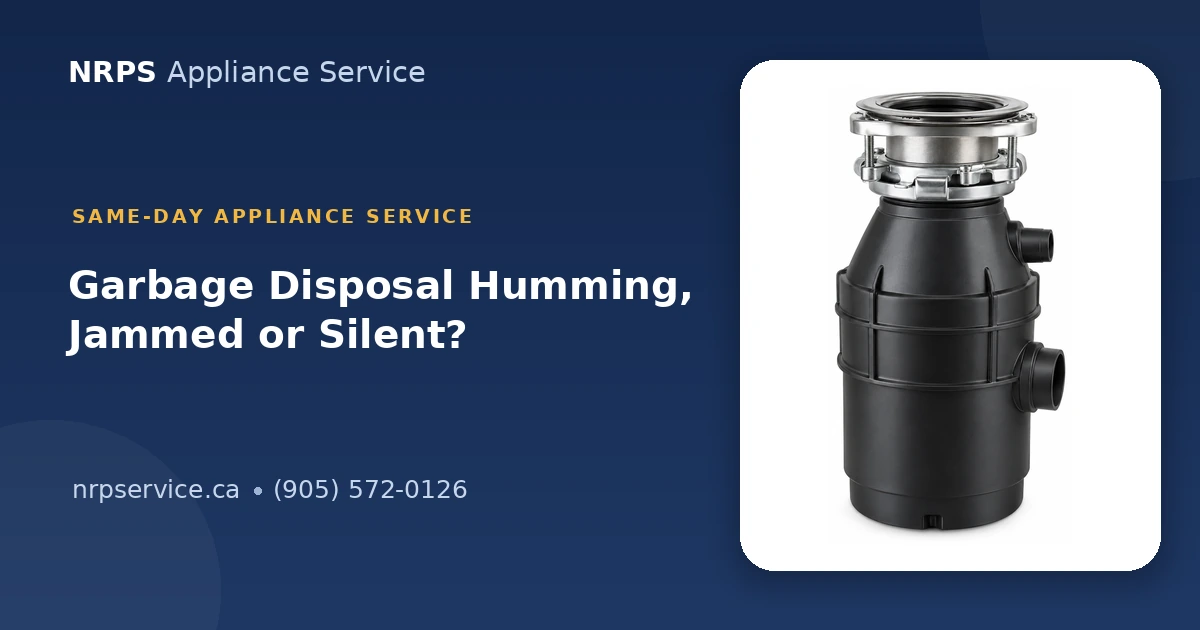
Garbage Disposal Humming, Jammed or Silent?
Disposal humming but not turning, or completely silent? The sound tells you the fault. Two free fixes solve most cases, and one rule keeps you safe.
A garbage disposal gives you a very clear clue about what is wrong, and almost nobody uses it. The sound it makes when you flip the switch tells you which fault you have, and two of the most common faults cost nothing at all to fix.
Before any of that, one rule, because this is the appliance people are most likely to reach into.
Never put your hand into a disposal. Not to feel around, not to pull something out, not even when the switch is off. Switches fail and get bumped. If you need to reach inside, turn the power off at the breaker first, not just at the wall switch, and use tongs or pliers rather than fingers.
What is it doing when you flip the switch?
|
What you hear |
What it means |
|
A hum, but nothing turns |
The motor has power and the grinding plate is jammed. Very common, and usually fixable in minutes. |
|
Nothing at all, complete silence |
No power reaching the motor. Usually the reset button or the switch, rarely the motor itself. |
|
Grinding, rattling or a metallic clatter |
Something hard is in there, often a bottle cap, a spoon or a bone fragment. |
|
It runs, then stops partway |
Overheating and tripping its own thermal protection, usually from overloading. |
|
It runs normally but drains slowly |
A clogged drain line rather than a disposal fault. |
|
It runs and water appears underneath |
A leak, which comes from a specific set of places listed below. |
If it hums: it is jammed
The motor is energised and the grinding plate cannot turn. Leaving it humming overheats the motor, so switch it off straight away.
1. Turn the power off at the breaker, not just the wall switch.
2. Look under the sink at the bottom of the disposal for a hex shaped socket in the centre. Most units come with a small hex wrench, often clipped to the side of the unit or taped to the bottom.
3. Fit the wrench and work it back and forth. You are freeing the plate, not forcing it, and you will usually feel it break loose.
4. Use tongs to remove whatever caused the jam if you can see it.
5. Restore power, then press the reset button underneath, which is usually small and red.
6. Run cold water and switch it on briefly.
If you have no hex wrench, some units can be freed from above with a long wooden implement used as a lever against the grinding plate, with the power off at the breaker. Never use your hand, and never leave the switch on while you work.
If it is silent: start with the reset button
This is the free fix, and it accounts for a large share of the disposals people believe have died.
Every disposal has a thermal overload protector with a reset button on the underside of the unit. When the motor overheats or overloads, it cuts power to protect itself and stays off until the button is pressed. Nothing announces this, so from above the appliance appears completely dead.
7. Reach under the sink and find the small reset button, usually red, in the centre of the base.
8. Press it firmly. You should feel a click.
9. Try the switch again.
If the reset does nothing, check the breaker, and check whether the disposal is plugged into an outlet under the sink that may itself be switched or tripped. Beyond that, the wall switch or the motor is the next step, and that is where a technician comes in.
If it leaks, the location tells you the part
• From the top, around the sink flange: the plumber's putty seal has failed where the unit meets the sink.
• From the side: usually the dishwasher inlet hose connection or the main drain line connection.
• From the bottom of the unit: an internal seal has gone, and that is normally the end of that disposal rather than a repair.
What should never go down it
Most disposal faults are caused rather than developed, and the list is short enough to remember.
• Fibrous vegetables, such as celery, corn husks, artichokes and onion skins. The strands wrap around the plate.
• Starchy foods, particularly pasta, rice and potato peel, which swell and turn to paste in the drain.
• Grease and oil, which pour in as liquid and set as solid further down the line.
• Coffee grounds, which accumulate into a dense sludge.
• Bones, fruit stones and shells, which are the usual cause of the grinding noise.
Two habits that prevent most of this: always run cold water before, during and for a few seconds after using the disposal, and feed waste in gradually rather than packing the chamber and then switching on. Cold water keeps fats solid so they are carried away rather than coating the pipe.
If your dishwasher is involved
Disposals and dishwashers share a drain path, so a blocked disposal can stop the dishwasher draining and leave standing water in it. If both appliances are misbehaving at once, our guide to standing water in the dishwasher explains how the shared path works, including the knockout plug that is often the culprit on a new installation.
Garbage disposal repair
NRPS repairs and replaces garbage disposals from all major brands, including jams, motor faults, switch and wiring problems and leaking connections. Our pricing is flat and confirmed upfront, and the details are on our garbage disposal repair service page.
Fewer surprises with a care plan
If you would rather not deal with faults like this at all, an NRPS care plan includes labour, gives you priority scheduling, and covers every appliance in your home under one membership. See how the care plans work →
Disposal humming, silent or leaking? Call (905) 572-0126 or book online, and keep your hand out of it until we arrive.