



Why Is My Range Hood Not Pulling the Smoke Out?
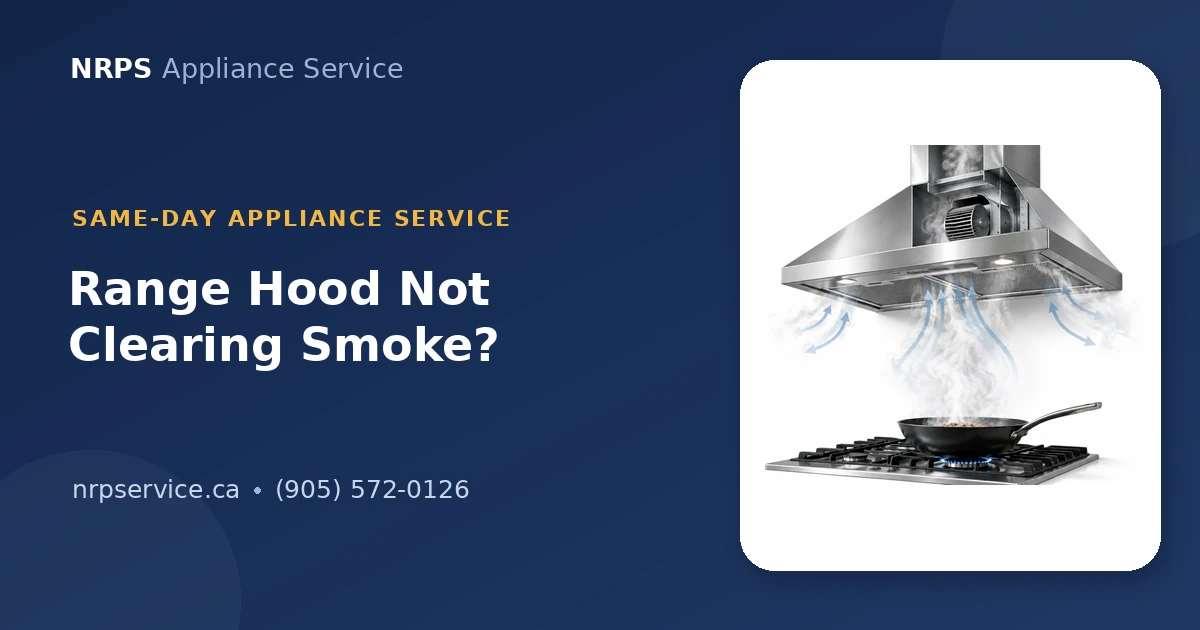
Why Is My Range Hood Not Pulling the Smoke Out?
Range hood running but smoke still fills the kitchen? Find out whether yours even vents outside, where the airflow is blocked, and when it is a fault.
The fan is running. You can hear it clearly. And yet the smoke from the pan drifts straight past it and settles across the kitchen, the windows fog up, and the whole house smells of dinner an hour later.
Before assuming the motor is failing, there is one question that decides everything else, and a surprising number of homeowners do not know the answer for their own kitchen.
First: does your hood actually vent outside?
There are two kinds of range hood, and they perform completely differently.
|
Type |
What it does |
|
Ducted |
Pushes air through a duct and out through a wall or roof cap. Removes smoke, steam, grease and odour from the house entirely. |
|
Recirculating, also called ductless |
Pulls air through a charcoal filter and blows it back into the room. Removes some odour and grease. It cannot remove steam or heat, because the air never leaves. |
How to tell which you have: look at the top of the hood. If a duct runs up into the cabinet, the ceiling or the wall behind, it is ducted. If the top is closed and air blows out through slots at the front or top of the hood, it is recirculating.
This matters more than anything else here: a recirculating hood will never clear steam and will never make the kitchen feel like a vented one does. If that is what you have, the disappointment may not be a fault at all. It is the design.
If yours is recirculating: the charcoal filter
Recirculating hoods have two filters, and this is where nearly all of them fail. The metal mesh grease filter is washable and most people know about it. Behind or above it sits a charcoal filter, and that one is not washable. It saturates with grease and odour, and once saturated it both stops absorbing and chokes the airflow.
Charcoal filters are consumables. They typically need replacing every six to twelve months depending on how much you cook, and a great many have never been changed at all in the life of the hood. If your recirculating hood has slowly become useless, this is the first thing to check and one of the cheapest to fix.
If yours is ducted: follow the air out
A ducted hood only works if air can travel the whole way outside. A restriction anywhere in that path shows up as weak suction, and the further along the path you go, the less likely anyone has checked it.
The grease filters
The metal mesh panels under the hood collect grease, and once they are loaded, air cannot pass through freely. They are dishwasher safe on most models, or they can be soaked in hot water with degreaser. Every month or two is realistic for a kitchen in regular use. This is the most common cause of gradual suction loss.
The blower and its housing
Grease that gets past the filters coats the fan blades and the housing. A heavily coated blower is both heavier and less aerodynamic, so it moves far less air while sounding exactly as loud as ever. That combination fools people into thinking the fan is fine.
The damper flap
Just above the blower sits a small flap that opens when the fan runs and closes when it stops, so outside air does not blow back in. Grease makes these stick. A damper stuck closed means the fan runs against a sealed duct and moves nothing at all, which produces the exact symptom of a hood that sounds healthy but does nothing.
The duct itself
Long runs, tight bends and flexible ribbed ducting all cost airflow. Flexible ducting is particularly bad, because the ribbed interior creates turbulence at every inch of its length. If the hood has never worked well since installation, the ductwork is a likely reason rather than the appliance.
The exterior cap, the part nobody checks
At the far end, where the duct exits through the wall or roof, there is a cap with flaps or a louvre. This is the least inspected part of the entire system and one of the most common blockages we find. Birds nest in them. Lint and grease build up on the flaps. The flaps corrode or stick shut. Some are fitted with an insect screen that clogs solid within a couple of years.
It is easy to check. Run the hood on high and go outside. You should feel a clear flow of air and see the flaps open. If nothing is coming out, the problem is at that end, not inside your kitchen.
Matching the symptom
|
What you notice |
Where to look first |
|
Slowly got worse over years |
Grease filters, then the blower and the charcoal filter if recirculating. |
|
Fan sounds normal but nothing moves |
A stuck damper flap, or a blocked exterior cap. |
|
Never worked well since it was installed |
Ductwork, hood size or mounting height rather than a fault. |
|
Steam is never cleared, odour partly is |
A recirculating hood behaving exactly as designed. |
|
Fan only works on one speed |
The speed switch or control board. |
|
Fan hums but will not start |
A seized motor or a failed capacitor. |
When it is the hood itself
If the filters are clean, the damper moves freely and air is clearly coming out of the exterior cap, then the appliance is the problem. The usual faults are:
• A failing blower motor, which turns more slowly than it should or seizes altogether.
• A failed capacitor, which typically leaves the motor humming without starting.
• The speed switch or control board, which shows up as one speed working and the others not, or the controls responding erratically.
• Worn motor bearings, which usually announce themselves with noise before performance drops.
• Lighting faults, which are separate from the fan and often just a lamp or a switch.
Two installation truths worth knowing
Some hoods were never going to perform well, and no repair changes that.
Size. A hood should be at least as wide as the cooking surface, and ideally a little wider. A narrow hood over a wide range will always let smoke escape at the edges, because the smoke rises outside its capture area.
Height. Mounted too high and the plume spreads before it reaches the hood. Mounted too low and it becomes a hazard over a gas burner. Manufacturers give a range, usually somewhere around 65 to 75 centimetres above the cooking surface, and staying inside it matters more than people expect.
What you can check yourself
1. Identify whether your hood is ducted or recirculating.
2. Remove and wash the metal grease filters, or run them through the dishwasher.
3. If recirculating, find out when the charcoal filter was last replaced. If nobody knows, replace it.
4. Look up inside the hood with the filters out and check the blower and damper for heavy grease.
5. Run the hood on high and go outside to confirm air is actually leaving the exterior cap.
6. Test each fan speed and the lights separately, since that tells a technician a great deal.
Turn the power off at the breaker before reaching inside the hood, and leave the wiring, motor and capacitor to a technician.
Range hood repair
NRPS repairs range hoods from all major brands, including under cabinet, wall mounted, island and integrated units. Blower motors, capacitors, speed switches, dampers and lighting faults are all routine work. Our pricing is flat and confirmed upfront, and the details are on our range hood repair service page. If your cooktop underneath is also giving trouble, our cooktop repair service covers that.
Maintenance handled for you
If you would rather not keep track of filters and cleaning, an NRPS care plan includes labour, priority scheduling and whole-home appliance coverage under one membership. See how the care plans work →
Range hood not clearing the air? Call (905) 572-0126 or book online and we will find out where the airflow stops.