




Why Is Fabric Softener Left in My Front Load Washer Dispenser?
Why Is Fabric Softener Left in My Front Load Washer Dispenser?
Fabric softener not dispensing in your front load washer? How the siphon works, why it fails, what to clean, and when the water inlet valve is the cause.
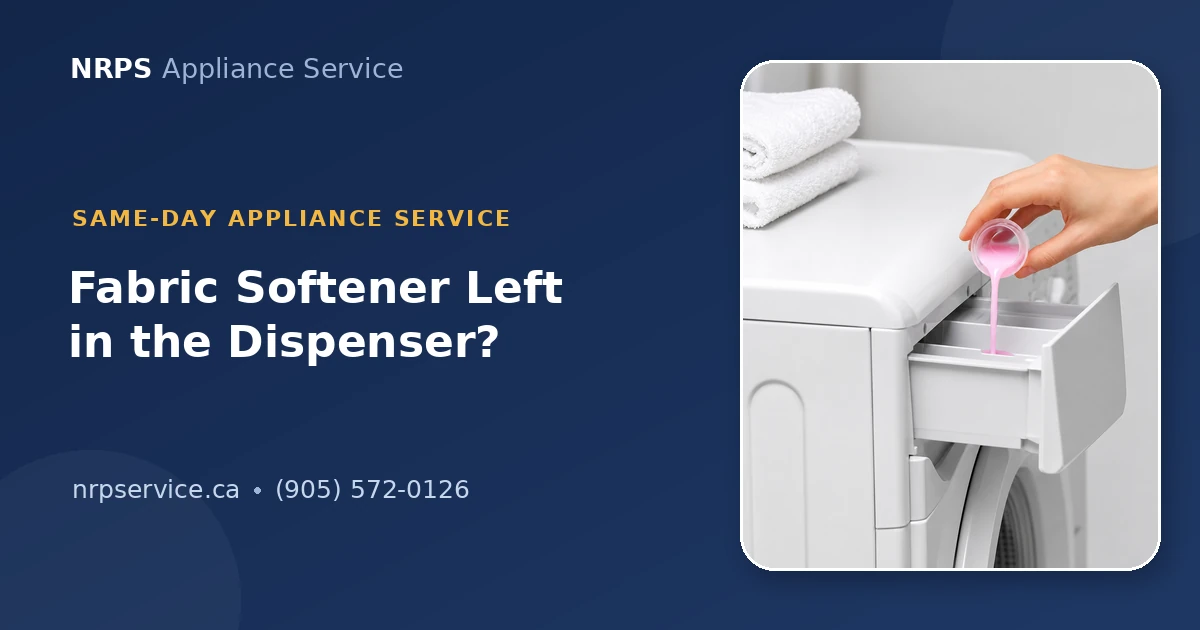
You open the dispenser drawer after a wash and the fabric softener is still sitting there, barely touched. It is one of the most common front load washer complaints, and the usual assumption is that the drawer is clogged. Sometimes it is. Often it is not. To work out which, it helps to know that fabric softener is not poured in like detergent. It is pulled out by a siphon, and a siphon needs specific conditions to work.
How the dispenser actually works
Detergent goes into the drum at the start of the wash. Fabric softener does not, because adding it early would simply wash it away. Instead it waits in the compartment until the rinse cycle.
When the rinse begins, the washer opens the cold water inlet valve and pushes water through the dispenser. That flow of water creates a siphon, which lifts the softener up over the siphon cap and carries it into the drum. The whole system relies on water arriving with enough force at the right moment.
The key point: the softener does not drain out on its own. It has to be siphoned out. So when softener is left behind, the real question is not “what is blocking the drawer” but “why did the siphon fail”.
Three things the siphon needs
Every cause of this fault comes back to one of three requirements. Working through them in order is the fastest way to find the problem.
|
Requirement |
What goes wrong |
Typical cause |
|
Enough water flow |
Not enough pressure to start the siphon |
Faulty cold water inlet valve, low household pressure, kinked or restricted hoses |
|
A clear path |
Water cannot move through the compartment properly |
Residue in the drawer, a blocked siphon cap, clogged dispenser nozzles |
|
Correct timing |
The valve never opens during the rinse |
Electronic control not energizing the valve |
The most common cause: a failing cold water inlet valve
Here is the detail that explains most of these calls. Many front load washers have two cold water solenoids inside the inlet valve assembly. During the fabric softener rinse, both are designed to open together, because one alone does not deliver enough flow to create the siphon.
If one of those solenoids fails, the washer still fills and still runs normally, so nothing looks broken. The only symptom is that the softener stays in the drawer, because the reduced flow is no longer strong enough to lift it. That is why this fault is so easily mistaken for a clog, and why cleaning the drawer does not fix it.
The other causes worth checking
• Residue in the drawer or siphon cap. Detergent and softener build into a thick film over time and block the siphon. This is the most common genuinely simple cause.
• Low household water pressure. If pressure is weak throughout the house, the washer may never reach the flow the siphon needs.
• Kinked or restricted supply hoses. A hose crushed behind the machine, or an inlet screen packed with sediment, reduces flow in exactly the same way as a failing valve.
• Blocked dispenser nozzles. The jets that spray water into the compartment can scale up or clog, especially in harder water areas.
• A control board not energizing the valve. Less common, but if the valve is never told to open, no amount of cleaning will help.
What to try yourself
1. Pull the dispenser drawer right out. Most release with a tab or catch at the back of the softener compartment.
2. Remove the siphon cap, the small plastic cover in the softener section, and check that the tube underneath is clear.
3. Soak the drawer and cap in hot water and clean off the residue, including inside the siphon tube.
4. Look up into the empty drawer housing and check the nozzles are not blocked.
5. Check the supply hoses behind the washer for kinks, and make sure the taps are fully open.
6. Refit everything and run a rinse cycle with softener to test.
If the softener now clears properly, the problem was residue and you have solved it. Keep the drawer clean every couple of months and it should not return.
When it is time to call a technician
If the drawer and siphon cap are clean, the hoses are clear, the taps are open, and the softener still sits in the compartment after every rinse, the fault is almost certainly in the water supply system rather than the dispenser. At that point a technician can test the inlet valve solenoids, confirm whether both are opening, verify the flow reaching the dispenser, and check whether the control board is energizing the valve at the right point in the cycle. Replacing a failed inlet valve usually restores normal operation straight away.
Worth knowing: this is a genuinely small repair with a clear diagnosis. It is not a reason to replace a washer, and it does not indicate anything seriously wrong with the machine.
Front load washer repair in Hamilton
NRPS Appliance Service diagnoses and repairs water inlet valve faults, dispenser problems and other front load washer issues on all major brands, across Hamilton (including Ancaster, Dundas, Stoney Creek and Waterdown), plus Burlington, Oakville, Grimsby, St. Catharines and Caledonia. Our pricing is flat and confirmed upfront, and the details are on our washing machine repair service page.
Fewer surprises with a care plan
If you would rather not deal with faults like this at all, an NRPS care plan includes labour, gives you priority scheduling, and covers every appliance in your home under one membership. See how the care plans work →
Softener still sitting in the drawer? Call (905) 572-0126 or book online and we will find out why.