



Why Is My Fridge Warm but the Freezer Still Cold?
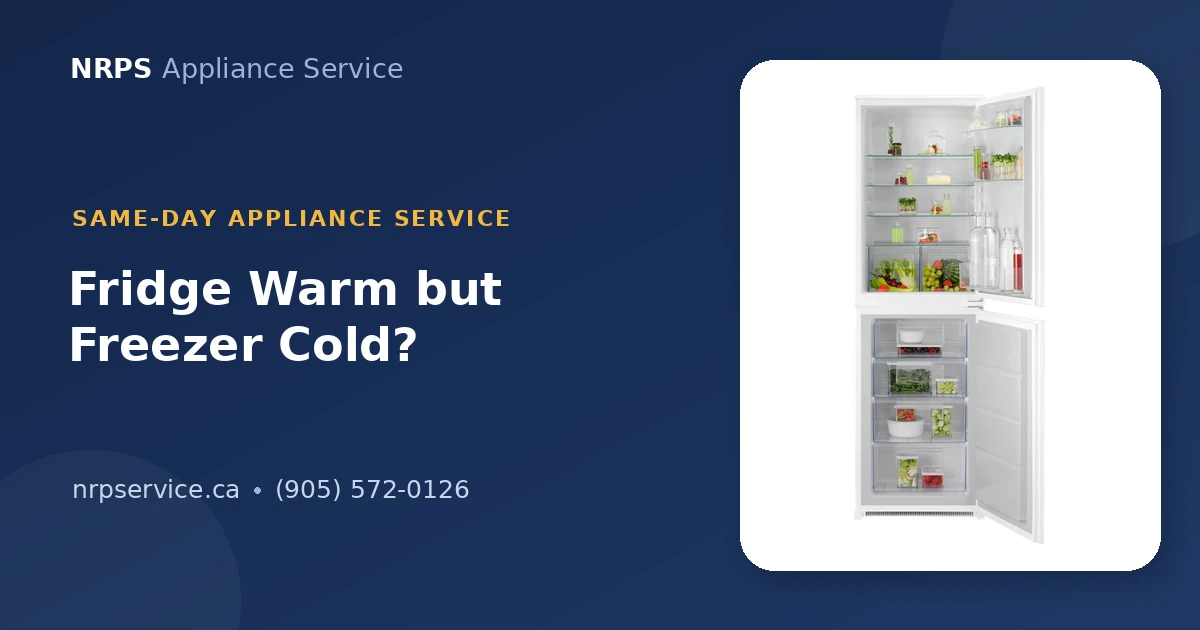
Why Is My Fridge Warm but the Freezer Still Cold?
Fridge section warm while the freezer stays frozen? The cooling is usually fine. The problem is the cold not reaching the fridge. Here is how to tell why.
The milk is warm, the vegetables are going limp, and yet the ice cream in the freezer is rock solid. It feels contradictory, and it is one of the most common refrigerator calls we get. It is also one of the most misdiagnosed, because people assume the fridge is dying when in most cases the cooling system is working perfectly well.
Understanding why comes down to one piece of design that most owners have never been told about.
Most fridges only make cold in one place
In the majority of household refrigerators, there is a single cooling system, and it lives in the freezer. Behind the back panel of the freezer sits the evaporator, the part that actually gets cold. The freezer is cold because it is standing next to the source.
The fridge section has no cooling of its own. Instead, a fan blows cold air from the freezer through a duct into the fridge compartment, and a damper controls how much gets through. Cold is made in one place and shared with the other.
That is the whole insight: if the freezer is cold and the fridge is not, then cold is still being made. It simply is not arriving. That rules out the compressor and the sealed system almost entirely, which is the expensive scenario people fear most.
So what stops the cold arriving?
Four things, in rough order of how often we find them.
1. The evaporator fan has failed
This fan is what physically moves air from the freezer into the fridge. When it stops, the freezer stays cold, because it is still beside the evaporator, while the fridge slowly warms up. A very common failure, and a genuinely affordable repair.
You can often check it yourself. Open the freezer and listen: you should hear a fan running. Many models stop the fan when the door opens, so hold the door switch in with your thumb while you listen. Silence, or a rattling and grinding noise, points at the fan.
2. Frost has blocked the airflow
A refrigerator defrosts itself on a cycle, melting the frost that naturally builds on the evaporator. When the defrost system fails, frost keeps accumulating until it forms a wall of ice over the coils and blocks the duct. The fan can be running perfectly and still be pushing air against a block of ice.
The clue is often visible. Take everything out of the freezer, remove the back panel if you can access it easily, and look for heavy ice buildup. Another telltale sign is a fridge that works normally for a day or two after being switched off overnight, then fails again, because the frost melted and then rebuilt.
3. The damper is stuck
The damper is the small door in the duct that regulates how much cold air reaches the fridge. Stuck closed, the fridge gets nothing. Stuck open, it overcools and can freeze produce. On older models it is a mechanical flap, on newer ones it is motorised and controlled by the board.
4. The vents are blocked by food
The simplest cause, and worth checking first because it costs nothing. The vents inside the fridge, usually at the back wall or the top, need clear space around them. Push a large container or a stack of leftovers against one and you have effectively closed the duct yourself. The same applies to a freezer packed so tightly that air cannot circulate back.
Quick checks, in order
1. Move food away from the vents inside both compartments and leave it a few hours.
2. Check the temperature settings, in case they were knocked. The fridge should sit around 3 to 4 degrees, the freezer around minus 18.
3. Listen for the evaporator fan in the freezer, holding the door switch in.
4. Look for heavy frost or an ice wall at the back of the freezer.
5. Check the fridge door seal, since a poor seal lets warm humid air in continuously and makes everything else worse.
6. Vacuum the condenser coils at the back or underneath, because a fridge working too hard struggles to keep up.
What each symptom tends to mean
|
What you notice |
Most likely explanation |
|
No fan noise in the freezer |
Failed evaporator fan. |
|
Thick ice at the back of the freezer |
Defrost system fault, so frost has blocked the duct. |
|
Works again after being off overnight, then fails |
Classic defrost fault. The ice melted, then rebuilt. |
|
Fan runs, no ice, but no air from the vents |
A stuck damper. |
|
Produce freezing at the back of the fridge |
Damper stuck open, or a thermostat or sensor fault. |
|
Both compartments warm |
A different problem entirely. See the section below. |
If both compartments are warm
That changes the diagnosis completely, because now cold is not being made at all. The likely causes are the condenser fan, the start relay, the control board, or the sealed system and compressor.
The last of those is worth being straightforward about. Sealed system faults, meaning refrigerant leaks and compressor failures, fall outside our standard refrigerator repair. If that turns out to be the cause, we will tell you immediately rather than after a long diagnosis, so you can weigh replacement against a warranty claim. On some brands, particularly LG, the compressor may still be covered by a long manufacturer warranty, which is covered in our LG fridge repair guide.
A note on newer and premium models
Some higher end refrigerators use dual evaporators, meaning a separate cooling system for each compartment. On those, a warm fridge with a cold freezer genuinely can mean a fault in the fridge side cooling rather than an airflow problem. It is less common, but it is why the model number matters and why a technician does not assume before checking.
How urgent is it?
More than most appliance faults, for a straightforward reason. A fridge sitting above roughly 4 degrees is no longer keeping food safely, so there is a real cost every hour it runs warm. The freezer being fine gives a false sense that things are under control.
The practical advice is to move anything perishable into the freezer or a cooler while you work through the checks above, and to treat the repair as time sensitive rather than something for next week.
Refrigerator repair
NRPS repairs refrigerators from all major brands, including evaporator fans, defrost systems, dampers, thermostats and control faults, on French door, side by side, top freezer and built in models. Our pricing is flat and confirmed upfront, and the details are on our fridge repair service page. For a broader look at fridge problems, see our complete guide to fridge repair.
Keep every appliance covered
If you would rather not be caught out by a failure like this, an NRPS care plan includes labour, priority scheduling and whole-home appliance coverage under one membership. See how the care plans work →
Fridge warm while the freezer stays cold? Call (905) 572-0126 or book online, and move the perishables somewhere cold while you wait.