



Why Does My Front Load Washer Knock During the Spin Cycle?
Why Does My Front Load Washer Knock During the Spin Cycle?
Front load washer knocking or banging during the spin cycle? Worn shock absorbers are the usual cause. Why it happens, and why ignoring it gets expensive.
The wash runs quietly enough, then the spin cycle starts and the machine begins hammering. A fast, repetitive knocking, tak tak tak, loud enough that you can hear it from another room. Most people assume the drum bearings have gone, which is the expensive diagnosis, and start bracing for bad news.
More often than not, the bearings are fine. On a machine that has a few years behind it, the usual answer is worn shock absorbers, and that is a considerably better outcome.
The timing tells you the part
Washer noises are easier to diagnose than most people expect, because when the noise happens narrows the cause dramatically. Before anything else, work out exactly when yours occurs.
|
When you hear it |
What it usually points to |
|
Only at high spin speed, fast and rhythmic |
Worn shock absorbers, the most common cause on an older machine. |
|
Throughout the whole cycle, a constant grinding or rumble |
Drum bearings, which is the bigger repair. |
|
Only occasionally, on big or heavy loads |
Load imbalance rather than a fault. Redistribute and retest. |
|
From the first day the machine was installed |
Shipping bolts that were never removed. Very common on new installs. |
|
A single clunk at the start and end of spin |
Often normal, as the tub settles. Worth watching rather than worrying about. |
If your noise sits in the first row, fast and rhythmic and only at high speed, read on. That is the pattern this article is about.
What shock absorbers actually do
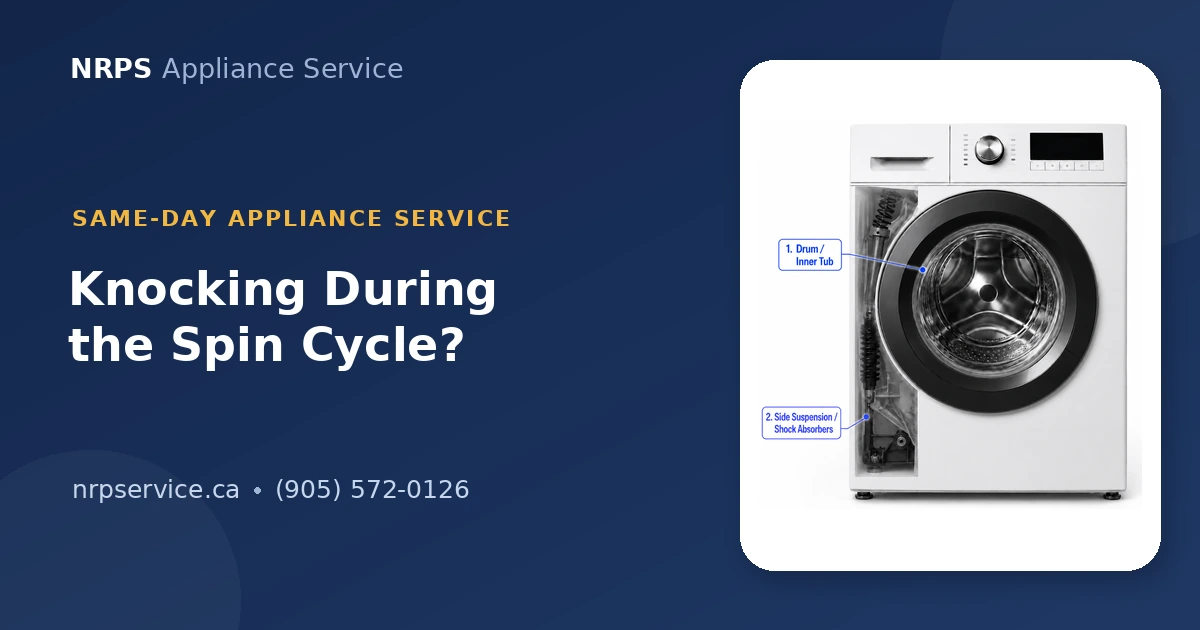
Inside the cabinet, the wash tub does not sit rigidly in place. It hangs on springs and rests on shock absorbers, which is what lets a front loader spin at well over a thousand revolutions a minute without shaking itself apart. The springs carry the weight. The shock absorbers do something different: they damp the movement, absorbing energy so the tub settles rather than bouncing.
They wear gradually. There is no moment of failure, just a slow loss of damping over years of use, which is why the noise creeps in rather than appearing overnight.
Why worn shocks make that specific noise
Once the damping weakens, the tub moves further than it should during spin. It travels, reaches the limit of its movement, and knocks against the cabinet, then does it again on the next rotation. At spin speed that repeats many times a second, which produces the fast, rhythmic tak tak tak people describe.
It also explains why the noise appears only at high speed. At wash speed the tub barely moves, so weak shocks are not tested. Push the speed up and the forces multiply, and that is when the weakness shows.
The other signs that confirm it
Worn shock absorbers rarely arrive alone. Alongside the knocking you will usually notice several of these:
• Noticeably more vibration during spin than the machine used to produce
• The cabinet walking or shifting across the floor
• Laundry coming out wetter than it used to, because full spin speed is never reached
• Spin cycles taking longer, as the machine repeatedly slows down and tries to rebalance the load
That last pair is worth understanding. The control board monitors imbalance, and when the tub is moving too much it backs off the speed and starts again. So the machine is not just noisy, it is also washing less effectively, and that is a cost you are paying every load.
Why this is not one to put off
A knocking washer is easy to live with, so people do, sometimes for a year or more. That is the expensive mistake, because the shock absorbers are not the only thing taking the punishment.
Every excess movement transfers force into the parts around it. The suspension springs stretch. The drum bearings, which are precision components, take loads they were never designed for. The spider support at the back of the drum flexes repeatedly. The concrete counterweights work loose on their bolts. Each of these is a far larger repair than a set of shock absorbers, and the bearings in particular often mean dismantling most of the machine.
The honest summary: worn shock absorbers are one of the cheaper front load washer repairs. The parts they destroy if left alone are among the most expensive. Acting early is not upselling here, it is genuinely the difference between a small job and a large one.
What else a technician will check
Shock absorbers are the usual answer, not the only one. A proper diagnosis rules out the alternatives, because the symptoms overlap:
• Suspension springs, which can stretch or break and produce similar movement.
• Drum bearings, where the noise is generally a constant grinding through the whole cycle rather than a knock at spin.
• The spider support at the rear of the drum, which can corrode and crack, particularly on machines run mostly on cold, short cycles.
• Loose counterweights, the concrete blocks that stabilise the tub, which can work loose on their mountings.
• Shipping bolts, which hold the tub rigid in transit and must be removed at installation. If they were never taken out, the machine will be violently noisy from day one.
• Levelling, since a machine that is not sitting flat will amplify every other issue.
How the repair is done
Shock absorbers are replaced rather than adjusted. They are also replaced as a complete set rather than individually, and there is a practical reason for that. They wear at roughly the same rate, so fitting one new shock alongside three tired ones leaves the tub unevenly damped, which often means the noise returns within months. Replacing the set restores even support across the tub.
Once done, the tub is properly controlled again. The knocking stops, vibration drops back to normal, spin speeds recover, and laundry comes out as dry as it used to.
What you can check before booking
1. Run a spin with a small, evenly distributed load. If the knocking continues, it is not the load.
2. Check the machine is level, with all four feet firmly on the floor and the lock nuts tightened.
3. If the washer is newly installed, confirm the shipping bolts were removed from the back panel.
4. Note whether the noise happens only at high spin, or throughout the cycle. Tell us which when you book, because it genuinely changes what the technician brings.
Beyond that, leave the panels closed. The tub, springs and counterweights are heavy, and the suspension is under tension.
Front load washer suspension repair
NRPS diagnoses and repairs suspension and noise problems on front load washers from all major brands, including shock absorbers, springs, bearings and counterweights. Our pricing is flat and confirmed upfront, and you will find the details on our washing machine repair service page. If your washer is also failing to reach a proper spin, our guide to why a washer tumbles instead of spinning covers the drainage side of that symptom.
Fewer surprises with a care plan
If you would rather catch faults like this before they escalate, an NRPS care plan includes labour, priority scheduling and whole-home appliance coverage under one membership. See how the care plans work →
Washer knocking during the spin cycle? Call (905) 572-0126 or book online, and get it looked at before it takes the bearings with it.