





Why Are My Dishes Not Coming Out Clean?
Why Are My Dishes Not Coming Out Clean?
Food left on dishes or a white film on glasses? A dishwasher needs four things to clean. Work out which one is missing, and what to do about it.
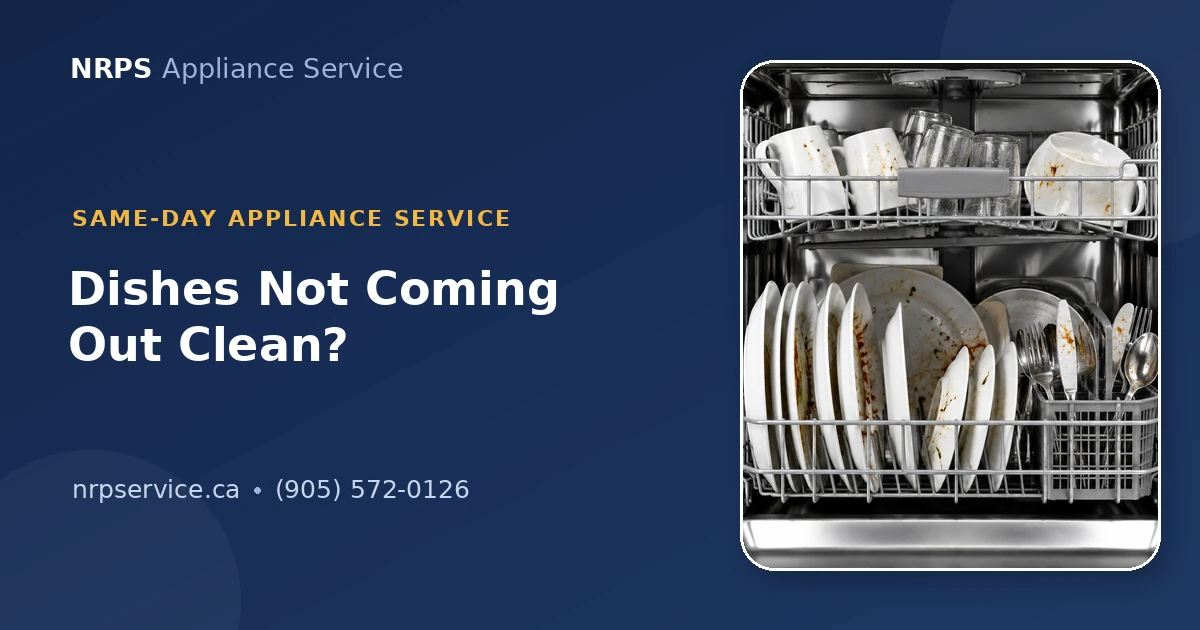
You unload the dishwasher and half the plates need doing again. Grit in the bowls, dried food welded to the cutlery, or a chalky white haze over every glass. It is the complaint we hear most about dishwashers, and it has more possible causes than almost any other appliance symptom.
There is a simple way to cut through that. A dishwasher only needs four things to clean properly, and every cleaning failure is one of the four going missing. Work out which one, and the cause follows.
The four things a dishwasher needs
|
Requirement |
What it does, and what happens without it |
|
Water |
Enough of it, arriving with pressure. Without it, the spray arms cannot reach everything. |
|
Heat |
Hot water dissolves grease and activates detergent. Without it, fats simply move around and resettle. |
|
Chemistry |
Detergent to break down soil, rinse aid to help water run off. Without it, soil redeposits. |
|
Movement |
Spray arms turning freely and reaching every surface. Without it, whole sections come out untouched. |
Use this as your shortcut: look at how the dishes failed rather than that they failed. Gritty food points to one requirement, greasy film to another, and white chalk to a third. The pattern is the diagnosis.
Match the residue to the cause
|
What you see |
What it usually means |
|
Gritty food particles, redeposited everywhere |
A clogged filter. Dirty water is being recirculated. |
|
Greasy film, cloudy but not chalky |
Water not hot enough, or too little detergent. |
|
White chalky spots that wipe off |
Hard water minerals. Rinse aid and cleaning help. |
|
Permanent cloudiness that will not wipe off |
Etching on the glass, which is not reversible. |
|
One rack or one area clean, the rest not |
Spray arms blocked or obstructed by loading. |
|
Dried food baked on, worse than before washing |
Heat present but water or spray coverage missing. |
1. Water: is enough getting in?
If the machine is not filling properly, everything else fails regardless of how good your detergent is. Low household water pressure, a partly closed supply valve under the sink, a kinked inlet hose, or a clogged inlet screen will all reduce the fill.
A quick check: pause the cycle a few minutes in and look at the bottom of the tub. There should be a visible pool of water sitting below the filter area. If it looks noticeably shallow, the fill is the place to start.
2. Heat: is the water actually hot?
Detergent needs heat to work, and grease needs heat to dissolve. Two things commonly go wrong here.
The first is outside the appliance. If the dishwasher is far from the water heater, the first water it draws in is whatever was sitting cold in the pipe. Running the kitchen tap until it turns hot immediately before starting the cycle solves that, and it is free.
The second is inside. The heating element or the thermostat can fail, so the machine fills and runs but never reaches temperature. That produces exactly the greasy, still dirty results people describe, and it is a repair rather than a habit change.
3. Chemistry: detergent and rinse aid
Detergent
Old detergent is weaker detergent. Powders and tablets absorb moisture over time and lose effectiveness, so a box that has been open for a year is not doing what it should. Store it somewhere dry and closed.
Also check the dispenser actually opened. If you find an undissolved tablet sitting in the bottom of the tub, or detergent still in the compartment at the end, the door of the dispenser was blocked, usually by a large plate or a baking tray leaning against it.
Rinse aid, and hard water
If your complaint is white spotting rather than food, this is where the answer lies. Rinse aid changes how water behaves so it sheets off instead of drying in droplets, and droplets are what leave minerals behind. In harder water areas it matters more, not less.
One important distinction. Chalky white marks that wipe off are mineral deposits, and rinse aid plus a dishwasher cleaner will improve them. Cloudiness that will not wipe off is etching, a permanent change to the glass surface caused by a combination of soft water, excess detergent and high heat over time. Etching cannot be reversed, only prevented on the glasses you still have.
4. Movement: can the spray reach everything?
The filter
This is the single most common cause of poor cleaning. The filter catches food so it is not sprayed back onto your dishes. When it clogs, the machine recirculates dirty water, which is why the failure often looks like food being added rather than removed. On most modern machines it twists out of the floor of the tub, and it wants cleaning monthly.
The spray arms
Spin each arm by hand. It should turn freely without catching. Then look at the holes: they block with seeds, labels and mineral scale, and a blocked hole means a dry patch somewhere in the load. Clearing them with a toothpick or a wire takes a few minutes.
Loading
Loading causes more cleaning complaints than any mechanical fault. A few habits fix most of it:
• Make sure nothing tall blocks the spray arms from turning. Check by spinning them after loading.
• Face soiled surfaces toward the centre, where the spray comes from.
• Do not overlap plates, since water cannot reach a surface that another plate is covering.
• Keep large trays and cutting boards out of the front row, where they block the detergent dispenser.
• Scrape food off, but do not pre rinse completely. Modern detergents need some soil to work against, and a spotless load can actually clean worse.
When it is a genuine fault
If the filter is clean, the spray arms turn freely and are clear, the detergent is fresh, the rinse aid is topped up, and the load is sensibly stacked, and the dishes still come out dirty, then something has failed. The usual candidates are:
• The heating element or thermostat, so the water never gets hot enough.
• The wash pump or its motor, so pressure at the spray arms is too low.
• The water inlet valve, so the machine underfills.
• The detergent dispenser latch, so it never releases at the right point in the cycle.
• The diverter valve, which alternates spray between the upper and lower arms and, when faulty, leaves one rack permanently poorly washed.
That last one is worth knowing, because it produces a very specific and often misread symptom: one rack consistently clean, the other consistently not, regardless of how you load.
Dishwasher repair when cleaning fails
NRPS repairs dishwashers from all major brands, including built in and integrated units where replacement means matching your cabinetry. Heating elements, pumps, inlet valves, dispensers and diverter faults are all routine work. Our pricing is flat and confirmed upfront, and the details are on our dishwasher repair service page. If your machine is also holding water or leaving dishes damp, see our guides to standing water in the dishwasher and dishes coming out wet.
Maintenance handled for you
If you would rather not keep track of filters and cleaning cycles, an NRPS care plan includes labour, priority scheduling and whole-home appliance coverage under one membership. See how the care plans work →
Dishes still coming out dirty? Call (905) 572-0126 or book online and we will work out which part of the process has failed.